Economic Factors >
Tax Governance
Tax Governance
Tax Governance Policy
The Company has followed the "Responsible Tax Principles" and established the "Tax Governance Policy" for the Company and subsidiaries of the Group to respond to international trends in tax governance and taxation information transparency. The Policy states that the Board of Directors is the highest-ranking taxation risk management unit and it is responsible for forming the tax governance policies and supervising the execution and effective implementation of tax governance policies. The Administration Management Department is responsible for tax management and it regularly reports the implementation status of tax governance to the Board of Directors. It also pays the income tax for profit-seeking enterprises certified by the CPA in accordance with regulations each year.

Tax Governance Risk Management
Tax compliance risk and management
All subsidiaries of the Group file and pay taxes in accordance with tax laws. The Administration Management Department is responsible for compiling information and notifying subsidiaries for confirmation. The results are reviewed by the CPA of the Group and reported based on the internal hierarchical delegation of responsibilities. The Administration Management Department is the tax management unit and it is responsible for conducting 2 independent audits each year to ensure that tax personnel comply with internal operating procedures and tax laws for routine tax filing, filing for suspension of payment, annual filing and payment, and filing of various types of income. It is also responsible for reporting tax management to the Board of Directors.
Tax law management
Related personnel are consulted on the latest changes in regulations each month. In the event of changes in tax laws, we actively inquire the opinions of other financial institutions and discuss response strategies with the Group's CPA to adjust internal operating procedures and related policies at appropriate times and ensure that internal operations and management are consistent with regulations.
Improve tax governance capabilities
To ensure personnel responsible for tax governance are familiar with tax laws, the Group's CPA provides information on the latest developments in tax laws whenever necessary. Personnel also participate in external tax training courses whenever necessary to improve their professional skills.
Publication of tax information
The Group's disclosure of tax information is based on the tax information in financial statements audited and certified by the CPA firm, and it is disclosed through public channels such as the official website and the annual report for the shareholders' meeting.
Stakeholder Management
Internal stakeholders
All related-party transactions of the Company comply with the Transfer Pricing Principles and are implemented in accordance with standards for arm's length transactions. The income is mainly derived from non-related-party transactions.
External stakeholders
・Methods and channels for stakeholder engagement:
The Company's main external stakeholder is the government's tax authority which directly affects the Company's tax compliance. The Company completes routine tax filing, filing for suspension of payment, and annual filing within the deadline. Where there are questions regarding tax affairs, the Company actively communicates and consults personnel of the tax authority. In the event of notifications regarding supplementary explanation for tax affairs, the Company immediately prepares related information and responds to stakeholders within the deadline.
・Methods for promoting tax initiatives:
The Company's Tax Policy stipulates compliance with local tax laws and regulations. The Company mostly uses "exchange of ideas and proposals in the trade association" to discuss tax issues. The Bankers Association forms a consensus of a majority of members for the association or its Financial Holdings Tax Team to propose recommendations and communicate with stakeholders.
・We collect and consider the opinions of external stakeholders:
With regard to the collection of opinions on tax issue drafts, the Company actively communicates and discusses with stakeholders. We also collect and compile the opinions of other financial institutions or consult the Bankers Association before proposing the Company's views within the deadline for the solicitation of opinions.
Tax information by country
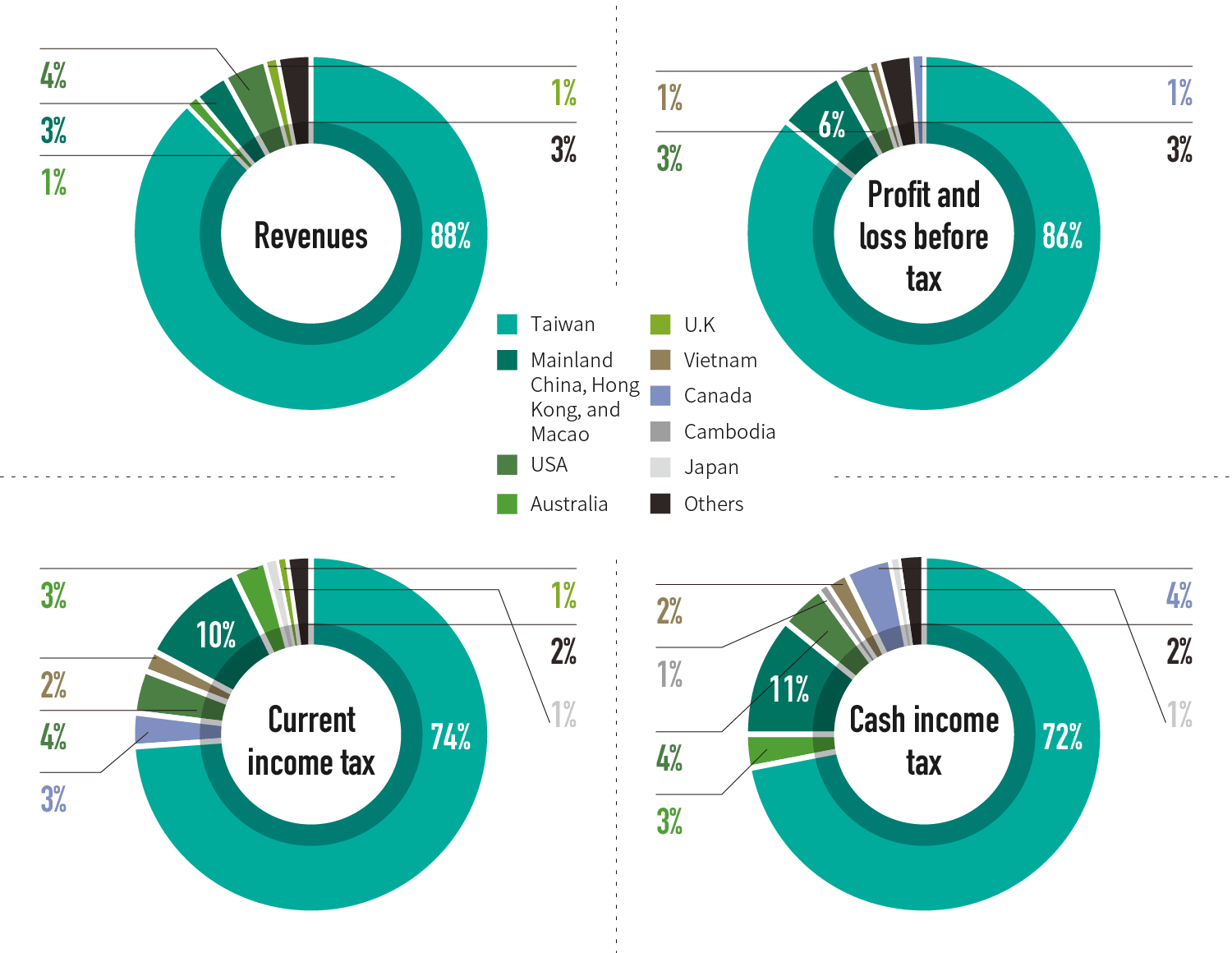
◎ The Group's revenues, operating profits and tax information in every country it operates around the world in 2024*1Unit: million NTD, %
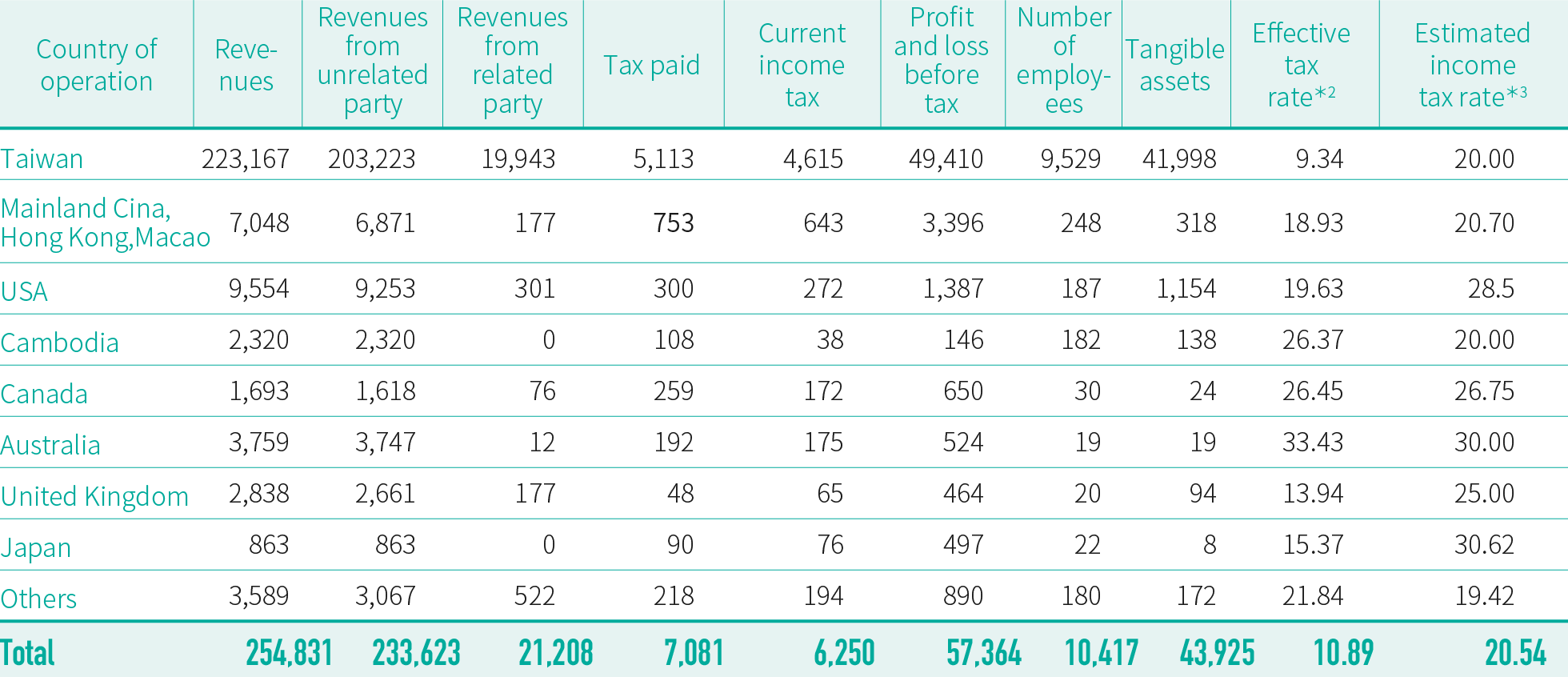
*1:This table is based on the total number of members required by Article 22-1 (country-by-country reporting) of the Regulations Governing Assessment of Profit-Seeking Enterprise Income Tax on Non-Arm's-Length Transfer Pricing.
*2:Total effective tax rate 10.89%=(49,410/57,365)*9.34%+(3,396/57,365)*18.93%+(1,387/57,365)*19.63%+(146/57,365)*26.37%+(650/57,365)*26.45%+(524/57,365)*33.43%+(464/57,365)*13.94%+(497/57,365)*15.37% +(890/57,365)*21.84%
*3:Expected income tax rate refers to the weighted average of pre-tax profit and loss and statutory tax rate of each country; (pre-tax profit and loss in country A * country A's statutory tax rate + pre-tax profit and loss in country B & country B's statutory tax rate...)/ (pre-tax profit and loss of countries A and B). If the pre-tax profit and loss generated by some countries is negative, they are removed from the table to avoid distortion.